Build a Running Structure That Helps You Run Faster
A simple, repeatable framework that shows recreational runners how to structure their week so every run has a purpose — and progress actually sticks (within 2–3 weeks).
🔒 100% Secure 256-Bit Security Encryption
If you’re running regularly but still feel inconsistent, fatigued, or unsure whether your training is actually working, the problem probably isn’t effort.
It’s structure.
Most recreational runners run often — but without a clear weekly framework. Easy runs drift too hard. Hard runs happen too often. Weeks aren’t repeatable. Progress stalls.
The Injury-Proof Running Week gives you a clear, performance-first system for structuring your training so you can improve without constantly starting over.
This isn’t a rigid training plan.
It’s a reusable weekly framework you can apply to any distance, any phase, and any busy schedule.
Structure your week so most runs actually help you recover
Use effort (not pace obsession) to train smarter
Place hard runs and long runs without wrecking the rest of your week
Progress performance without increasing injury risk
Build weeks you can repeat month after month
Delivered as a 36-page PDF with printable worksheets — so you can apply it immediately.
JOIN NOW FOR $27

Buy 'The Injury Free Running Week' For $27

🔒 100% Secure 256-Bit Security Encryption

Why So Many Runners Train Hard — But Still Don’t Improve
If you’ve ever felt frustrated after a week of running — wondering why you’re tired but not faster — you’re not alone.
Most recreational runners aren’t lazy or uncommitted. They’re doing the work. They’re getting out the door. They’re logging the miles.
And yet, progress feels unpredictable.
Some weeks feel good.
Other weeks feel flat.
And over time, motivation slowly erodes because effort doesn’t seem to lead anywhere.
Here’s what’s usually happening:
Easy runs slowly creep harder than they should
Hard runs show up too often — or too close together
Long runs drain the rest of the week
Every run feels “kind of hard,” but none feel purposeful
On paper, it looks like training.
Physiologically, it’s mixed signals.
And mixed signals create fatigue faster than fitness.

The Real Issue
The problem isn’t that you’re not trying hard enough.
It’s that your week is working against itself.
Without a clear structure:
Recovery never fully happens
Quality sessions lose their impact
Weeks stop being repeatable
And once weeks aren’t repeatable, consistency breaks — no matter how motivated you are.
That’s why so many runners get stuck in a cycle of:
push → feel run down → back off → restart → repeat
Not because they lack discipline —
but because they’ve never been shown how to structure a week that actually supports progress.
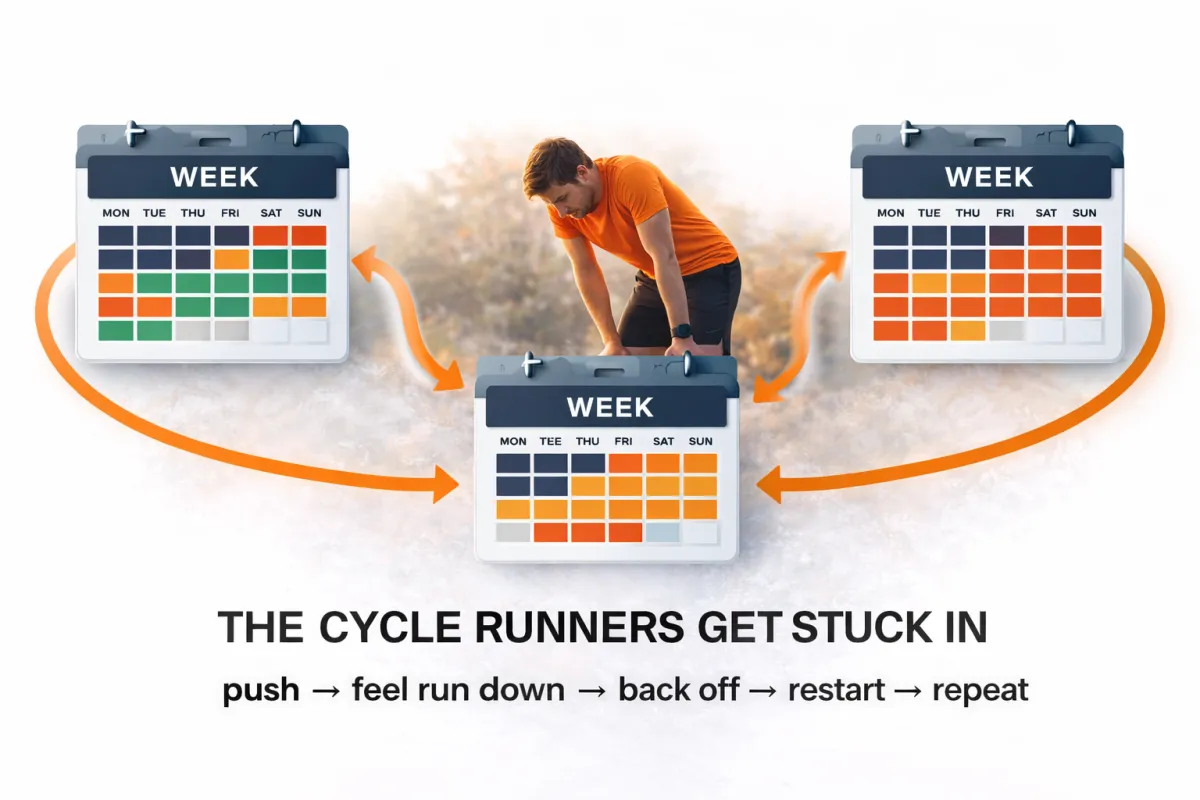
And until the structure changes, nothing else really does.

A Simpler Way to Train — One That Actually Works Long-Term
Once you understand that the problem isn’t effort — it’s structure — the solution becomes much clearer.
You don’t need another rigid training plan.
You don’t need to run more miles.
And you definitely don’t need to push harder every time you lace up.
You need a way to organize your week so your runs support each other instead of competing for recovery.
That’s exactly why I created The Injury-Proof Running Week.
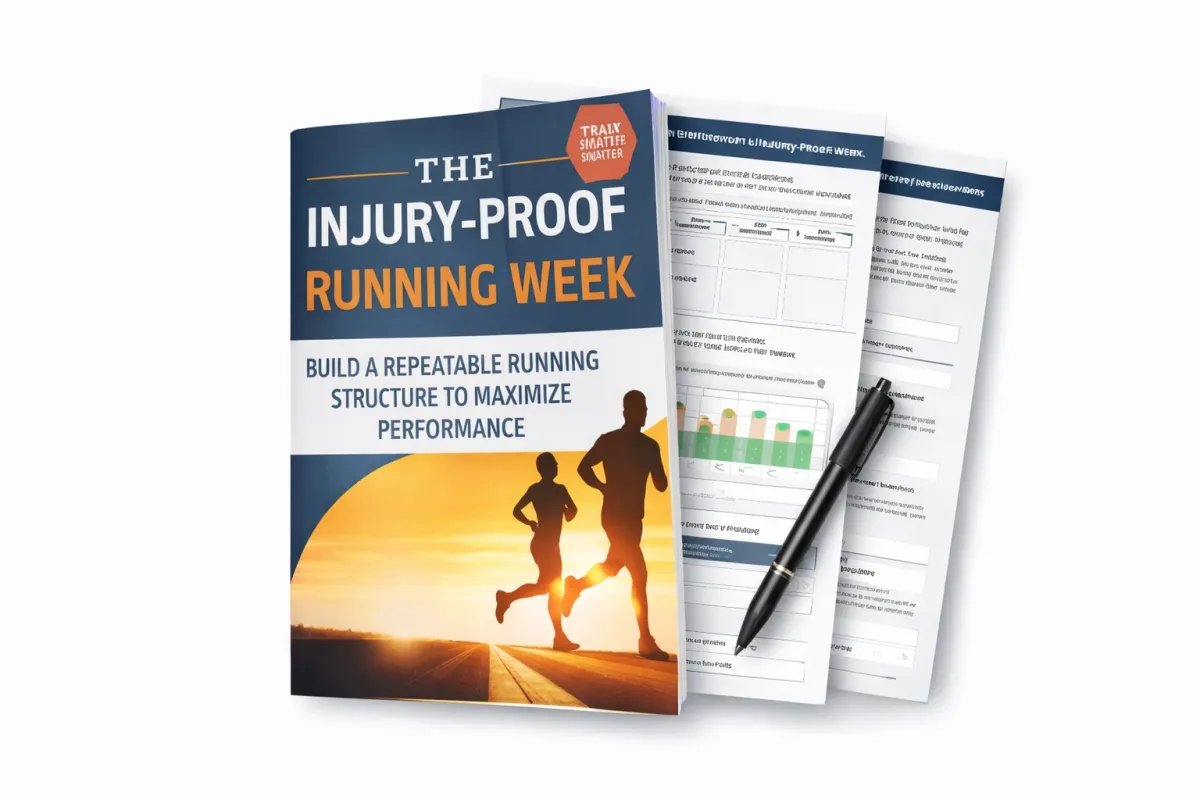
The Injury-Proof Running Week is a step-by-step, performance-first framework that shows you how to structure your weekly training so:
Easy runs actually help you recover
Hard runs create real adaptation
Long runs build durability without draining the rest of the week
And your training becomes repeatable — week after week
Instead of guessing how hard to run or when to push, you follow a simple structure where every run has a role.
This isn’t a training plan you follow once and discard.
It’s a decision-making system you can reuse for:
Any distance
Any season
Any level of motivation
Any busy schedule
Imagine finishing most weeks feeling:
Fresher instead of fried
Confident instead of uncertain
Clear on what’s working — and why
Not because you trained less seriously,
but because your training finally has a structure that supports consistency.
INCLUDED WITH YOUR ORDER
The Injury-Proof Running Week Bundle
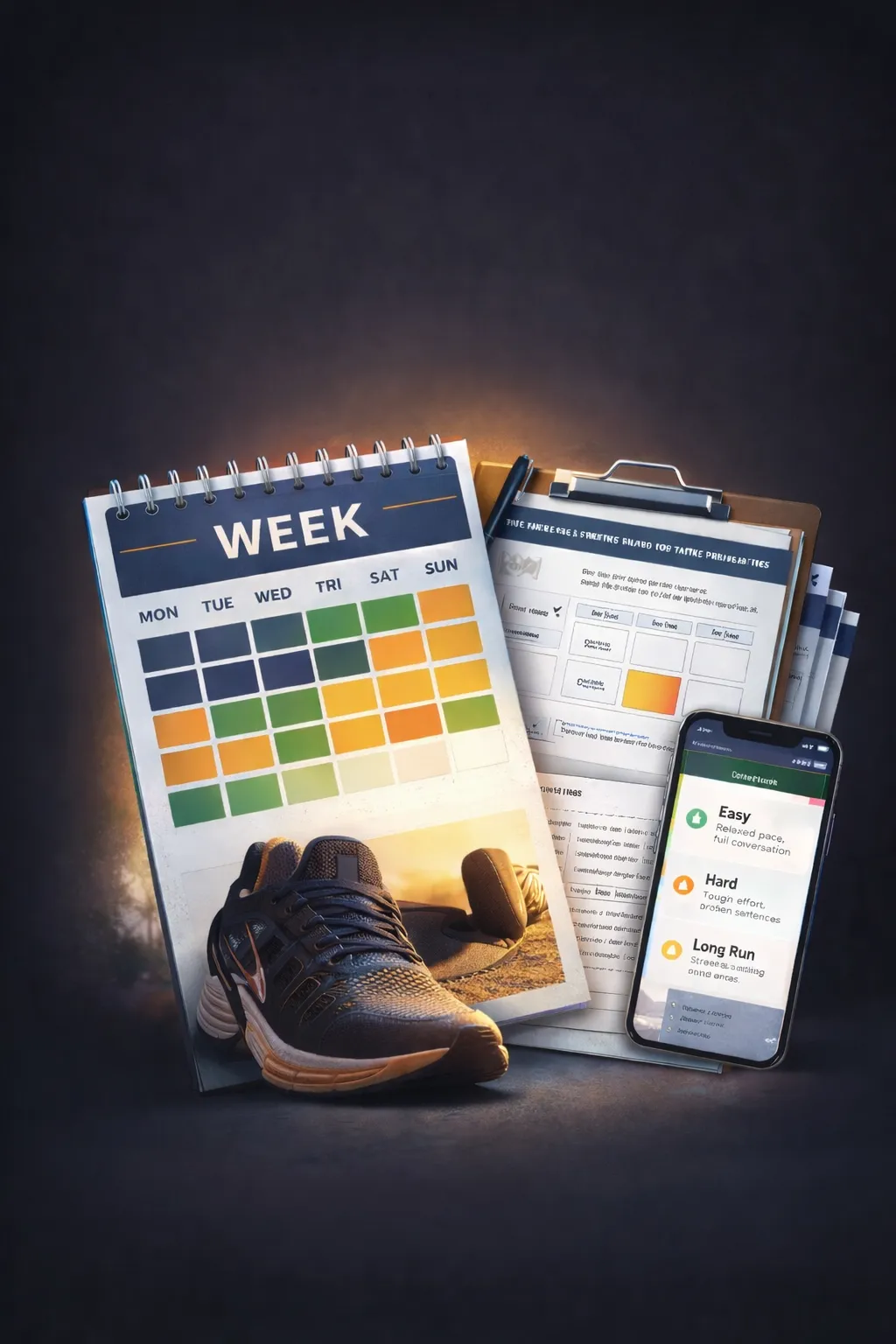


A Clear Weekly Structure (Not a Rigid Plan)
You’ll learn how to organize your running week so every run has a purpose — easy runs support recovery, hard runs drive adaptation, and long runs build durability without draining the rest of the week.
This isn’t a day-by-day plan you blindly follow. It’s a reusable framework you can adapt to your schedule, fitness level, and goals — now and in the future.

Train by Effort — Without Data Obsession
Instead of guessing pace or chasing numbers, you’ll use simple effort guidelines (RPE) so your training adjusts naturally to fatigue, stress, terrain, and real life.
This helps you avoid the “always kind of hard” trap that breaks consistency — and makes your training more sustainable long-term, even without a GPS watch or heart-rate monitor.

Tools That Turn Clarity Into Action
You’ll also get practical worksheets that help you apply the framework immediately — auditing your current week, building a repeatable structure, and knowing when to push or hold back.
These tools remove overthinking and second-guessing, so you always know what to do next — and can keep moving forward week after week.
Everything included is designed to help you train more consistently — without burning out, getting injured, or starting over
THE OLD WAY
(WHY MOST Runners Plateau)

Most runners are taught — directly or indirectly — that improvement comes from effort.
So they:
• Run hard whenever they feel good
• Push pace on easy days because it feels productive
• Add workouts when motivation is high
• Chase numbers without understanding recovery
It feels responsible. It feels committed.
But it quietly creates a problem.
THE NEW WAY
(How Progress Actually Happens)

The Shift
The runners who improve long-term don’t train harder.
They train with intent.
They organize their week so:
Most runs support recovery
One run provides a clear stimulus
The long run builds durability without draining everything else
Instead of asking, “How hard should I push today?”
They ask, “What role does this run play in my week?”
Here's Everything You Get
When You Get Access To The Injury Proof Running Week Today
The Injury-Proof Running Week Framework (36-Page PDF)
Estimated Value: $97
This is the core system.
You’ll get a step-by-step framework that shows you how to structure your week so every run has a purpose — and your training supports itself instead of fighting for recovery.
You’ll learn:
How to design weeks that actually improve performance
Why most runners plateau despite running consistently
How to structure your week so you can repeat it month after month
How to stop guessing whether your training “makes sense”
This isn’t something you use once and discard.
It’s a framework you can apply for years.

🧠 Module 1: The Consistency Audit
$49 Value
Spot hidden fatigue and gray-zone training
Understand why your current week isn’t repeatable
Fix problems at the root — not by adding more effort

🧱 Module 2: The Performance-First Weekly Framework
$79 Value
The 4 roles every run must play
How to build a minimum effective running week
Where to place hard runs and long runs safely
How to simplify training without losing results

🎚 Module 3: Effort Control Using RPE
$59 Value
What RPE really means (in practical terms)
How hard each run should actually feel
Simple intensity rules that prevent burnout
How to avoid the “always moderately hard” trap

📈 Module 4: Smart Progression Without Breaking Yourself
$69 Value
The only 3 ways performance actually improves
How to progress over 2–3 week cycles safely
How to tell productive fatigue from warning signs
How to remove emotion from training decisions

🗓 Module 5: Example Weeks & Long-Term Use
$49 Value
Example weeks for 3–4, 5, and 6-day runners
Common mistakes at each volume level
How to adapt the framework for busy weeks or race prep
How to reuse the system year after year

Printable Tools & Worksheets
$67 Value
Weekly Running Audit
Weekly Framework Builder
2–3 Week Progression Planner
Push-or-Hold Decision Sheet
Total Real-World Value: $468
Normal Price: $97
TODAY'S SPECIAL PRICE:
JUST $27
100% Secure 256-Bit Security Encryption
Why This Framework Exists (And Why It Works)
I didn’t create this framework because I wanted to sell a course.
I created it because, for years, my own running looked a lot like what most recreational runners experience.
I’d run when I could. Some weeks were consistent, others weren’t. Some runs were fast, some were slow, some were long — but there was no real structure tying them together.
Effort was there. Progress wasn’t.“Something you want to quote” — Author
I’ve been a recreational runner for over 22 years.
And like many runners, my biggest improvements didn’t come from training harder — they came when I finally committed to a simple, repeatable weekly structure.
When I stopped guessing and started structuring my weeks, consistency finally stuck.
Over time, that approach helped me improve my marathon time from 4:13 to 3:25 — not through hero workouts, but through weeks I could repeat month after month.
There’s nothing extreme or secret about this framework. It’s based on:
How endurance adaptation actually works
What allows runners to stay consistent long enough to improve
And what breaks runners down when structure is missing
The difference is that most runners are never shown how to organize their week around key principles — especially without a coach.
That’s the gap this system fills.
If you’re looking for shortcuts, hype, or promises of instant PRs, this isn’t that.
But if you want a clear, practical way to structure your running so progress becomes predictable instead of random, this framework will make sense immediately.
Is this right for you ?
A quick reality check !
I want to be very clear about what this is — and what it isn’t.
The Injury-Proof Running Week isn’t a magic fix.
It won’t run the miles for you.
And it won’t work if you skim it and go back to guessing.
What it will do is give you a clear, proven structure you can apply immediately — if you’re willing to use it.
Who This Works Best For
This framework is a great fit if you:
Are already running regularly (or trying to be)
Want to improve performance without burning out
Prefer clarity and structure over hype
Are willing to slow down on easy days to make progress long-term
If that sounds like you, this will make sense quickly.
Who This Is Not For (Important)
This probably isn’t the right product if you’re looking for:
A rigid, day-by-day training plan
Shortcuts or “secrets”
Guaranteed race times or PR promises
Something to follow without thinking
That’s intentional..
Value
I’ve priced this at $27 because I want it to be accessible — not because it’s incomplete.
You don’t need to “believe” in it blindly.
You just need to apply it honestly for a few weeks.
Most runners know very quickly whether their training finally feels calmer, clearer, and more sustainable.
If you’re ready to stop guessing — and start structuring your weeks with intent —
this is for you.
NOW FOR ONLY $27
Buy The Injury Proof Running Week
For $27
🔒 100% Secure 256-Bit Security Encryption